Magento vs. Shopify: Which Platform Is Best for You

Summarize

Chat GPT

Perplexity

Gemini

Claude
Most online stores choose one of the two mega-popular content management systems - Shopify or Magento. Both were developed with e-commerce in mind. Both offer extensive customization options. And both are compatible with hundreds of add-ons that cover all business needs. So which is the best option for you?
Today, let's compare Shopify and Magento in the context of creating a new online store to help you choose the best content management system to launch your own business.
Easily Create Your Pop-up with Claspo Free Shopify Plugin
Shopify vs. Magento: Pros and Cons
Both CMSs have a vast user base - 700,000 for Magento and over 2 million for Shopify. Despite their similar purpose, both platforms have different strengths and weaknesses. Read on to discover more.
Shopify Pros
Shopify focuses on the ease of creating an online store. This platform makes it possible to create an online store in days, if not hours. With a wide range of add-ons and a thriving community of experts, you won't need any assistance from third-party developers and designers.
When comparing Shopify vs. Magento, the former platform has the following advantages:
Ready to use from scratch
The basic CMS configuration already includes tools for sales, marketing, analytics, and reporting. Competing systems require each module to be installed separately.
Suitable for dropshipping
Shopify allows you to start a business without warehouses and logistics by entering into agreements with manufacturers and distributors. Special plugins for product search are also available.
Visual website builder
More than 95% of the work involved in creating an online store on Shopify can be done with a mouse. You don't need to write code and draw graphics manually.

Multichannel sales
A store on the Shopify platform can be scaled to popular marketplaces and social networks. The CMS is compatible with Amazon, eBay, Facebook, and Instagram.
Own payment system
The Shopify Payments gateway works in the US, Japan, Britain, Australia, and most EU countries. You don't have to find a separate financial service provider.
Shopify Cons
The primary value of the platform is maximum ease of use. But it has its downside - limited flexibility, which determines the following disadvantages:
Limited customization
Some elements of Shopify themes cannot be changed or customized. This is why many stores look similar to each other - experts can easily recognize the platform they are based on.
Additional fees for payments
Shopify's payment gateway charges up to 2.9% + 30 cents per transaction, and you'll have to pay up to 2% to connect to third-party services.
Expensive applications
The platform's internal store has several useful apps and beautiful themes. However, their cost can reach several hundred dollars - making it unaffordable for some small businesses.
Magento Pros
Magento, or rather Adobe Commerce, called CMS since 2021, used to be an open-source platform. It provides users with much more freedom - almost every element of it can be edited, adapting it to users' needs. This allows us to talk about its advantages, such as:
Maximum flexibility
Basic knowledge of HTML and CSS will allow you to create a truly unique online store comparable to sites without CMS.
High performance with modern themes
With the Hyvä theme, Magento delivers fast page load times and strong Core Web Vitals results. Since Hyvä recently became free, merchants now treat it as the default frontend choice for Magento stores. At the same time, smooth implementation and extension compatibility depend on working with a professional Hyva theme development company that understands both Magento architecture and the Hyvä tech stack.
Large selection of add-ons
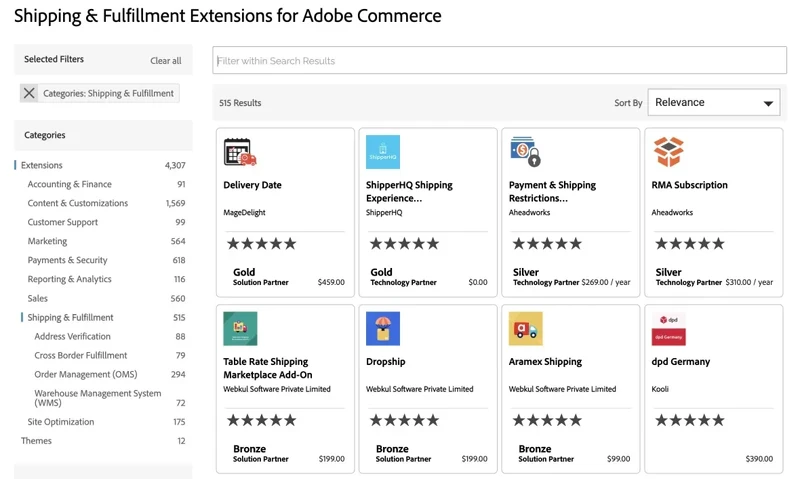
Adobe Commerce store offers more than 3600 applications. Their average cost is lower than the competitor's, so the pros and cons comparison of Shopify versus Magento shows the advantages of Magento.
Ease of integration
As the platform is based on an open-source solution, it can be quickly connected to other software, including CRM, ERP, and analytics systems.
Easy to scale
Magento makes it easier to expand product catalogs and launch multilingual sites. The platform allows you to customize different versions of the store by default, adapting them to regional peculiarities.
Magento Cons
As always, every advantage has its downside. The accessibility and adaptability of the platform have the following disadvantages:
Difficulty of use
Unlike Shopify, Magento requires advance preparation. Here, you will have to write the code yourself or hire a web developer.
Non-transparent pricing policy
Adobe Commerce offers customized pricing plans - to find out how much they cost, you'll need to contact support and answer a series of questions.
Weak out-of-the-box configuration
The basic version of Magento has no sales and marketing tools. You will also have to connect third-party payment gateways to it.
Magento and Shopify: Features to Compare
Both platforms are focused on e-commerce. Their basic pricing plans offer everything you need to launch an online store. Yet, Shopify and Magento have a lot of differences in terms of functionality. Let's consider them in more detail.
Sales
This is where Shopify confidently steps ahead. The basic configuration of the content management system already includes a point of sale (POS) module, which includes:
accounting system;
payment gateway;
balance management;
analytics;
allocation of staff responsibilities.
Shopify allows you to manage multichannel sales from a single dashboard by default. You can even order a physical terminal with a bank card reader and barcode scanner if required. By connecting it to the internet, the user has access to all features of the platform.
In Adobe Commerce, the sales module is installed separately. But you can do it with a free extension, although it will be inferior to Shopify in terms of analytics. However, Magento offers more convenient solutions for the B2B segment. The platform allows you to upload huge catalogs from spreadsheets, issue invoices, and request commercial offers.
Marketing and SEO
This is another area in which Shopify completely dominates. The built-in analytics service allows you to set KPIs, monitor their achievements, segment your customer base, and create personalized offers. It's also possible to optimize the site for keywords and conduct basic audits without involving third-party services. The only downside is that the basic tariff plan does not offer all the above features.
As for Magento, the platform also supports many marketing tools and SEO solutions, but as separate add-ons. Many of them are expensive, and others require deep technical knowledge for integration. Adobe Commerce also allows you to work with your customer base and promote your site, but it will be more protracted, more complex, and more expensive.
Payment system
On the one hand, Shopify provides its own payment gateway, so businesses in Europe, the US, Japan, and Australia don't have to "reinvent the wheel." Alternatives like PayPal, Stripe, and Amazon Payments are also available and can be switched to at no extra cost. On the other hand, this is where the list is limited. You can connect third-party payment systems, but then you will have to pay a double commission - Shopify will take up to 2% from each transaction.
Adobe Commerce uses a more liberal approach. It doesn’t have its own payment system. The same providers available in Shopify are available in Adobe Commerce by default, but you can also choose your own option without increasing the commission fees. From this point of view, Magento is better suited for a large business that sells its goods in several regions simultaneously.
Applications and extensions
Both content management systems allow you to download plugins from the built-in stores. Shopify leads in the number of applications - more than 8000. However, most of them require payment. Moreover, they are quite expensive - from tens to hundreds of dollars per month. Using ready-made solutions, you can fully automate the operation of an online store, but how profitable it will be is a separate question.
Among the interesting add-ons, we should mention QuickBooks accounting service, official applications of social networks like Instagram, TikTok, and Facebook, Userlike chatbot creation services, and Claspo, a platform for creating effective widgets for websites.
Claspo offers affordable pricing plans for businesses of all sizes, an extensive library of ready-made templates, multiple targeting and display options, and smart tools to prevent website bounce rates from rising. Claspo helped the MAUDAU e-commerce platform increase transactions by 19% and is ready to improve your online store's results.
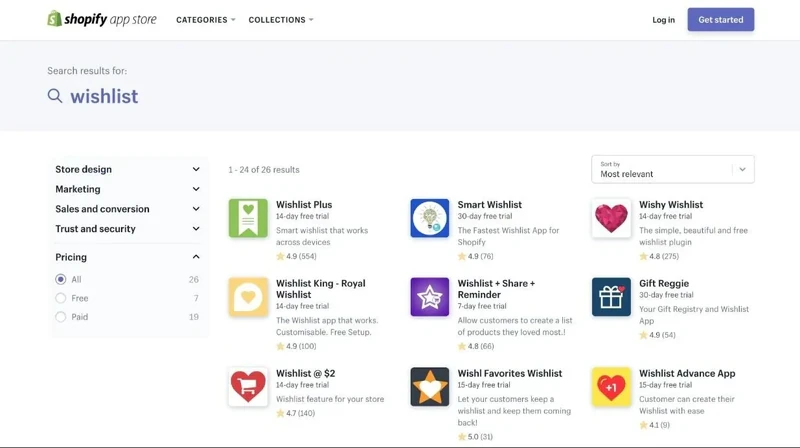
There are only 3600 plugins in the Adobe Commerce online store. But this cannot be called a disadvantage of Magento. Many more free add-ons are available, and automation will cost much less, especially for those who know how to write program code. In addition, the platform offers many ready-made solutions for integrating third-party services. Therefore, if you choose Magento, you can also use Claspo widgets to increase conversions on your website. Our plugin is not yet available on Magento, but you can easily integrate Claspo with your CMS through Google Tag Manager.
Convenience and tech support
Shopify is much easier to use. It takes minutes to familiarize yourself with the admin panel, after which you can manage your online store on your own. The platform provides 24/7 support. The help center has an extensive knowledge base. And for solving complex tasks, you can turn to Shopify's community of experts.
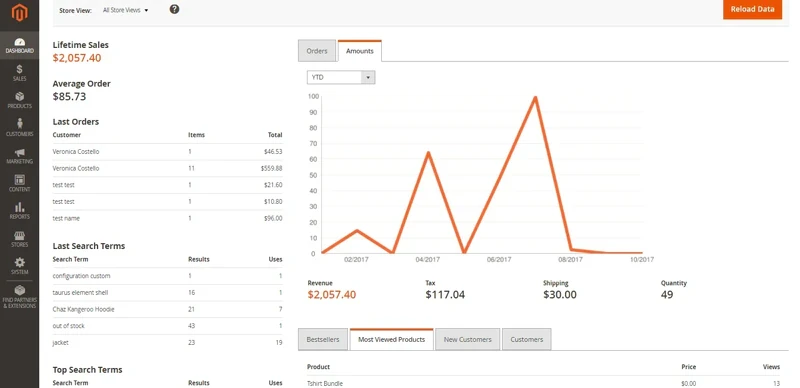
The Magento administration panel is more complicated - it is more focused on large businesses, where sites are managed by separate specialists. But if you spend a few hours studying the manual, you'll find that it's surprisingly well-structured - in fact, all functions are at your fingertips and don't require prolonged digging through menus. The platform also provides 24/7 support. If you have a problem, you need to start a ticket in the support service and keep track of its status. This is very convenient, especially if you already have experience in IT.
Try All Advanced Features with Claspo Free Lifetime Plan
Conclusion
We will declare Shopify the winner of our comparison for small businesses and startups. The platform is focused on the independent creation of an online store and site management. To do this, you will not need to hire an extensive staff. It is easier and cheaper to use ready-made plugins.
Magento is better suited for medium and large businesses. This content management system offers more freedom in terms of visual design and site customization. It supports more ways of integration and provides convenient tools for professional administration.
No matter what CMS your website is based on, you can unlock its full potential with Claspo.
Claspo allows you to create widgets for different marketing purposes easily without any technical skills. But our main feature is a set of tools that ensure that your widgets do not annoy site visitors and spoil their impression of your online store. And a good user experience is the key to conversions!
So you can choose between Shopify and Magento, but when it comes to a widget builder, the choice is clear!
Experience the Ultimate Shopify Upgrade with Claspo Widgets!
Start converting more visitors today. Get started in minutes and see results right after.