7 Marketing Metrics: The Complete Guide with Examples

Summarize

Chat GPT

Perplexity

Gemini

Claude
The key to automating business processes is using marketing metrics. Metrics of marketing are numbers that reflect the current state of a company and the effectiveness of its activities. Usually, their calculation is straightforward, sometimes even intuitive. But, the interpretation and ways to use these metrics may not be as obvious.
In this article, we will tell you which metrics you should track, their advantages and practical use difficulties, and how to combine metrics for your company effectively.
What are Metrics in Marketing
Marketing metrics are quantitative indicators that show the effectiveness of strategies, campaigns, or even specific business promotion tools. They are used to diagnose and analyze the company's activities. These indicators allow you to promptly make the right management decisions and adapt to changing market situations, competition, and consumer sentiment.
From the definition of metrics in marketing, it is clear that they are used to optimize tactics and strategies for business promotion. With a clear set of quantitative indicators, you can experiment and identify the best ways for the company's development and avoid all traps and obstacles.
To determine metrics in marketing that will give you the most benefit, you should rely on the following factors:
business model of the company;
characteristics of the target audience;
competition level in the market;
product life cycle;
communication channels.
7 Marketing Metrics to Track
Each company should build its own analytics system using the best marketing metrics that perfectly describe its activities. However, there are also universal metrics that will be useful for any business. Let's take a closer look at examples of marketing metrics.
1. Return on investment in marketing (ROI)
This key performance indicator will tell you how well your current marketing campaign is doing compared to previous ones. ROI is also often compared with industry benchmarks and the performance indicators of the closest competitors to assess the company's position in the market.

For example, you spent 100 thousand dollars advertising a new car model. The campaign resulted in sales of $1.5 million with a 20% margin. The profitability will be:

2. Conversion rate (CR)
This is a general-purpose type of marketing metric. A sale, subscription, phone call, etc., can be considered a conversion. The higher this level is, the more accurately you understand the needs of your target audience. CR will also be informative compared to previous periods, competitors' performance, or industry benchmarks.

For example, over the past month, your website has attracted 50 thousand visitors and 3,500 of them have subscribed to your newsletter. The conversion rate equals:

3. Cost of customer acquisition (CPA)
The list of marketing metrics should also include cost indicators. By comparing the average investment with the potential profit, you can understand the financial success of the campaign. If the overall result is negative, you need to change your approach to advertising.

For example, you spent $2,000 on social media activity that brought 98 new users to your SaaS service. This means that the CPA is:

4. Lifetime customer value
This indicator should also be included in the marketing metrics template to assess financial performance. You can use it to compare with the cost of customer acquisition. By analyzing the components of CLV and understanding how you can influence them, you can increase your business's revenue and profit.

Continuing with the previous example, let's add that the average subscription period for a SaaS service is 14 months, payment is monthly, and the tariff is $9.99. Customer lifetime value will be equal to:

This figure is higher than the cost per acquisition, which is $20.41, so the marketing campaign can be considered successful.
5. Click-through rate (CTR)
This is another marketing metric that is easy to interpret. The higher the score, the more accurately your online advertising is customized and the more attractive your message is. You can easily find benchmark values published in industry studies and available in public analytics systems like Google Analytics. It's also important to compare CTR with conversion: if your ad is much more effective than your commercial offer, it's likely misleading.

For example, you launched a contextual ad that had 15 clicks in 121 displays. The key performance indicator is equal to:

6. Retention and churn rates
This is another fairly simple but effective sample of marketing metrics. A sharp increase in churn or a decrease in retention may signal problems in customer communications. It's important to compare these metrics with market benchmarks because, in some segments, consumers don't tend to be too attached to brands.



For example, you had 35 thousand subscribers to your tech review channel at the beginning of the period. During the month, you gained 5 thousand subscribers and lost 3.5 thousand. This allows you to calculate the following indicators:


7. Widget conversion rate (CR)
In general, websites with widgets have 4 times higher conversion rates than websites without them. But at Claspo, we know that achieving a high rate is possible only with constant performance tracking and A/B testing of widgets. That's why our built-in analytics show the conversion rate of each widget, which is calculated using the formula:

For example, if your website widget was shown to 1,000 site visitors and 100 of them performed the targeted action (made a purchase, subscribed to the newsletter, etc.), the conversion rate would be:

Claspo allows you to monitor the widget conversion rate for different periods — from one day to the entire time it is displayed on your website. If you see that the conversion rate is not living up to your expectations, it may be time for A/B testing. Conduct it only after carefully analyzing and hypothesizing why your widget shows a specific result. It may depend on its design, messaging, location, time of appearance, etc.
Our analytics will display the key performance indicators of both A/B testing variations, help you understand whether your hypothesis was correct, and provide a strong foundation for optimizing the conversion rate of your widgets. With our simple builder, you can easily make all the necessary changes to the design or display rules to achieve the maximum result.
Still Not A User Of Claspo? Let's Fix It
Benefits of Using Marketing Metrics
The main advantage is the ability to make data-driven management decisions. Practice shows that, in most cases, numbers assess the business environment better than the intuition of a manager or a businessman. Quantitative marketing campaign metrics have other advantages, which we will discuss in more detail.
Optimization of budgets
When using the intuitive approach, it's hard to know how much money to invest in advertising. If you invest too little, it won't have the desired coverage; if you invest too much, it will be annoying and ineffective. To solve the problem, you need an analytics system based on specific numbers. You will always know how much profit each dollar invested in advertising will bring you.
Accelerated growth
In the 21st century, most markets are already highly competitive. Therefore, creating a profitable commercial offer for business development is not enough - you will still be in the shadow of large companies. However, key marketing metrics will help you determine which promotion methods are the most effective, which segments of your target audience like your product, and which communication channels give the best results. If you cannot be the strongest player, implement the most effective marketing strategy.
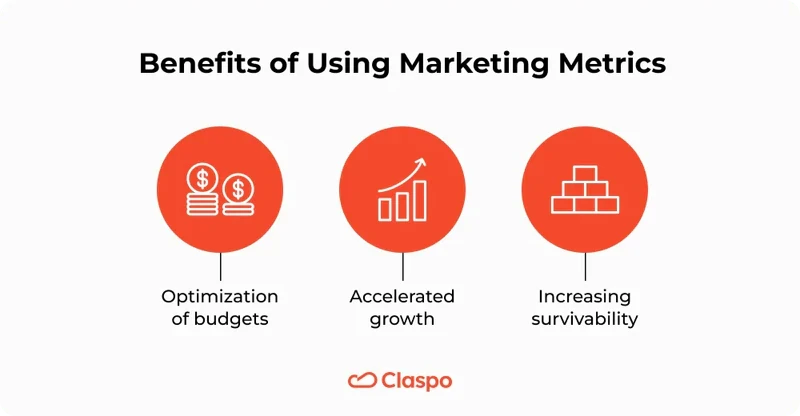
Increasing survivability
Economic crises are like tsunamis. These waves sweep away companies that have not managed to build a foundation strong enough to stay afloat. An analytics system based on quantitative metrics for marketing campaigns will make your business more resilient. It will allow you to predict the approach of these waves of financial instability, quickly adapt to new conditions, and more easily get through hard times.
Challenges of Using Marketing Metrics
Of course, there are no perfect solutions in business. Once you've built strong marketing analytics and metrics that accurately describe your company's performance, never forget about their drawbacks:
Numbers don't always contain all the information you need. Your customers are real people, not cells in a spreadsheet. Apart from quantitative metrics, you need to use qualitative data.
Focusing on marketing metrics to measure success can lead to failure. Managers often like to see only the positive in reports, so they ignore the whole picture and stop responding to changes in the business environment.
Marketing performance metrics need to be interpreted correctly; they are more than just formulas from a math textbook. Take into account the current position of the company and the market.
How to Choose the Proper Marketing Metrics
We've already mentioned above that each company should define its own key metrics for marketing to use to make decisions. But how do you decide which metrics are important for your business? We recommend that you take into consideration the following tips:
Important marketing metrics should reflect the company's goals. Metrics for expanding the audience and increasing profitability will be different.
The analytics system should be practical. Use the tools that match your current capabilities. Make sure they are accurate and reliable enough. For example, small businesses can't afford to use metrics based on Big Data and machine learning. So, they will have to look for more affordable tools like DashThis that provide excellent data visualization of all the marketing data across all platforms.
Marketing metrics will be effective if they can be used over time to compare competitors, target audience segments, or communication channels. They can't exist in a vacuum - every figure must be useful.
Still Not A User Of Claspo?
Start converting more visitors today. Get started in minutes and see results right after.