Shopify Review: 16 Pros and Cons

Summarize

Chat GPT

Perplexity

Gemini

Claude
Every platform has flaws, and Shopify is no different, so let’s look at Shopify’s pros and cons.
Shopify is among the world’s most popular e-commerce platforms, and for a good reason. You can quickly start a Shopify store without prior experience and begin selling online.
But should you choose this platform? Are the benefits not worth the trouble? Keep reading to get answers.
Shopify: Pros and Cons
You can find a short list of pros and cons of Shopify below. If that’s enough to convince you one way or the other—congratulations, that’s the end of the article for you! We hope to see you again soon!
However, if you want a more in-depth dive into Shopify’s pros and cons, we invite you to read further.
PROS | CONS |
1. Easy to use | 1. Poor language support |
2. Attractive design and themes | 2. Service dependency |
3. Scalability | 3. Hidden fees |
4. Security | 4. Price rise |
5. High download speed and excellent optimization | 5. Data transfer |
6. Mobile version is available | 6. Dependency on third-party apps |
7. Blog module | |
8. Programming language |
Pros of Using Shopify
Shopify is among the market leaders for a good reason. So, let’s start with the amazing things it brings to the table.
#1. Easy to use
Shopify is extremely easy to use as it has an intuitive interface. You can create a store and fill it with your first products in just a few clicks. Plus, it has clear instructions and good customer support to help you resolve any issues.
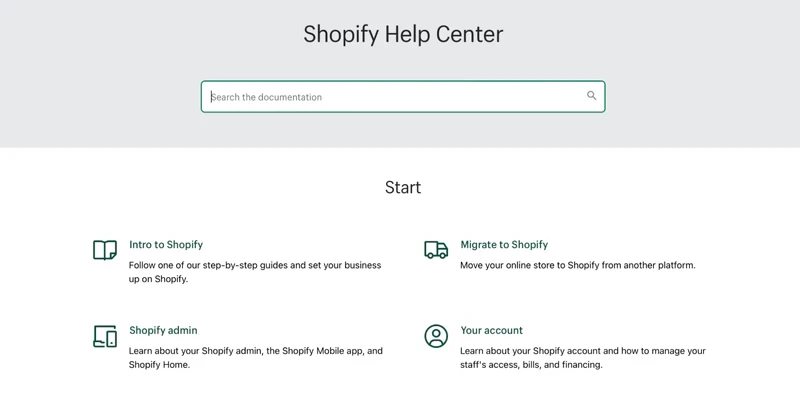
The platform does not require any technical skills. However, if you have the technical know-how and want to customize your store, you can turn on the developer mode.
#2. Attractive design and themes
The platform offers an in-built theme store where you can get various free or premium templates for your shop. There are many generic themes as well as templates catered for specific industries.
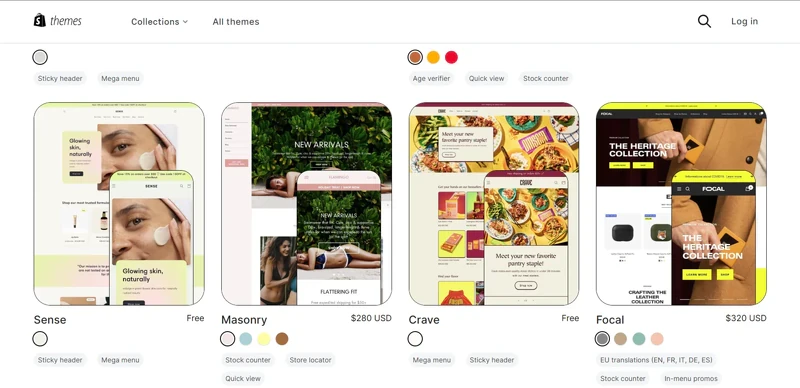
And if you don’t like what Shopify has, third-party vendors offer even more pre-made templates and custom-made themes just for you.
#3. Scalability
The platform allows you to easily scale your website and develop your business. You probably won't need all the platform features at first, but in the future, when sales go up, you will discover new management tools that will help you reach even more audiences.
To help you achieve your goals faster, you can install the Claspo app and reinforce your strategy with website widgets. We’ve already helped many e-commerce stores to improve results. Just look at MAUDAU. In just 2 days, our widgets increased their transactions by 19%. We would be happy to repeat this success with your business.
#4. Security
All your data is securely protected. Information is stored in the cloud and has several levels of protection. Therefore, you can be sure that your data, passwords, and logins will be safe. In addition, the site has proxy protection against DDoS attacks, which applies to mobile and PC versions.
#5. High download speed and excellent optimization
Thanks to Shopify’s server architecture, the platform ensures that all data loads quickly, even if you are in an area with poor Internet coverage. This brings you quick page load time, which is vital for retaining visitors: a tiny page load increase from 1 second to 3 seconds increases the bounce rate by a staggering 32%.

Just like Shopify, Claspo is conscious of this metric. Our scripts have the highest score on Google PageSpeed Insights, confirming that our widgets will not slow down your website’s loading speed.
#6. Mobile version is available
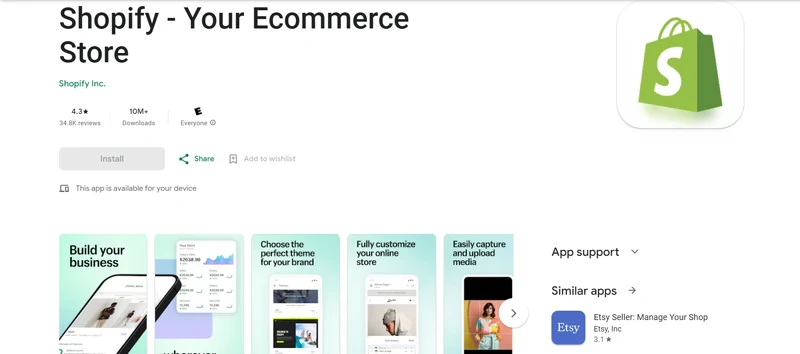
The platform has mobile applications for the two most popular operating systems—Apple and iOS. Optimization is carried out for each platform. That allows you to run applications even on the weakest devices. Mobile versions of the site offer the same features as the website version. Besides, they are also free.
#7. Built-in app store
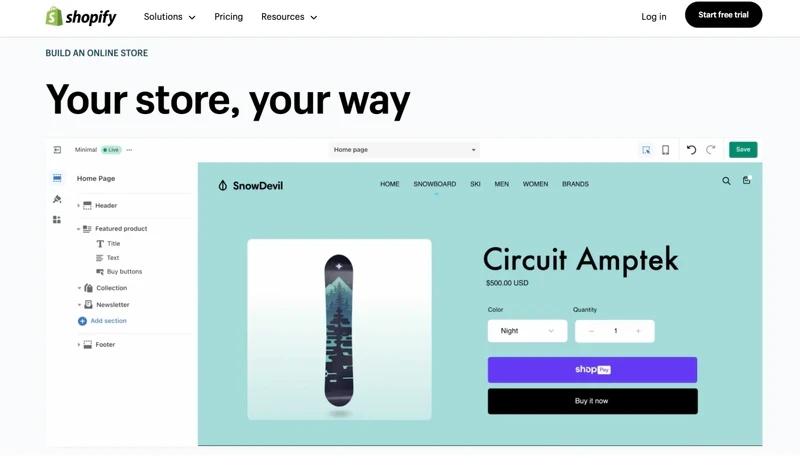
Shopify is a very modular platform. It is open to other services. Therefore, you can integrate almost any available modules and plugins into your site. You can choose the tools you need in the built-in catalog or upload your own, connect, and customize them to your needs.
Claspo is also a part of the Shopify App Store, so you can easily install your favorite popup builder on your online store. From there, you can quickly build high-converting widgets for any business goals in just a few minutes.
Like Shopify, Claspo features an intuitive interface that allows you to build from scratch or choose from hundreds of pre-made templates. Claspo’s widgets are your golden ticket to conversions and sales.
To reduce bounce rates, we ensure a non-intrusive user experience on your website by implementing automatic widget overlapping protection and customizable time intervals between widgets. Moreover, with Claspo, you can easily capture the international audience using geotargeting to show widgets in chosen countries, regions, and cities and set up dynamic language changes to make your message clear and appealing to multilingual shoppers.
#8. Payment and prices
The platform has a built-in Braintree gateway that makes it easy to set up and enable payments once the store is up and running. Thanks to this system, your payments and transactions will be protected from hacks.
Speaking of money, one of the advantages of Shopify is a reasonably low price for a monthly subscription. Choose from several pricing plans or enjoy a 14-day trial period that includes all of the platform’s functionality.
Cons of Using Shopify
With all the pros of Shopify, you’d think it’s the perfect platform for any store, and by now, they should have a monopoly on the space. However, it’s not all sunshine and rainbows. Let’s have a look at issues Shopify could work on.
#1. Poor language support
The platform has a significant bias towards the US and UK markets. It does pay out for them since they’re the #1 e-commerce platform in the US, with a respectable 28% market share.
Using the site's full functionality is only possible in English. Although the company is introducing new languages, they only allow you to use some features for now. You can use an app from the store for automatic translation, but they aren’t always accurate, and most aren’t free.
#2. Service dependency
There is some risk because all your data is stored exclusively on the company's servers. If the service stops working one day, you risk losing all your data, customer data, and other important information. Therefore, when working with the platform, it’s doubly important to make backup copies of all important information.
#3. Hidden fees
If you do not use the built-in Shopify Payments module, the platform will take a cut from any transactions in your store. The problem is that it’s not available in all countries. In this case, the user will have no choice but to pay additional fees for all their transactions while having worse transfer security compared to the built-in module.
#4. Price rise
At the beginning of its development, the platform had many free themes that allowed you to expand the store's functionality to suit your needs. However, over time, their number began to wane. More and more paid versions appeared in the store. Prices for some of which reach up to $300. It’s one of the disappointing disadvantages of Shopify.
#5. Data transfer
If you want to switch to another platform, it won't be that easy, as Shopify doesn't give you the ability to download all the data you need automatically. Therefore, to transfer data, you will have to copy all the necessary information manually. If you have a small store, this is not a big problem, but it gets more complex with thousands of customers.
#6. Dependency on third-party apps
While many users love Shopify App Store's customizability, others find it overwhelming and unnecessary. Plus, there are many paid apps, so your initially low investment can quickly turn into hundreds or even thousands of dollars per month. In the case of Shopify, flexibility quite literally comes with a great price.
However, not all amazing apps will break your wallets. For example, using a Shopify upsell app can help you increase your average order value in a cost-effective way, while still delivering strong results for your store.
However, not all amazing apps will break your wallets. For example, Claspo’s affordable price plans accommodate businesses of all sizes and budgets. Moreover, you can always start with our lifetime free plan to test the waters and see the first results without spending a penny.
#7. Blog module
Although the platform has a built-in blog module, it cannot boast a wide set of functions. It is inconvenient for working with large amounts of information, and therefore, users are more likely to try integrating third-party modules. However, Shopify has limited compatibility with these modules, which causes additional difficulties.
#8. Programming language
Shopify supports developer mode for more fine-grained store customization. However, the platform is built on Liquid, a programming language based on Ruby. While it has many advantages of its own, it is a niche language that even advanced users struggle with. While it is perfectly optimized for simple stores, complex templates with many loops, conditional statements, and nested structures can severely hinder your website’s performance.
Conclusion
Shopify's software allows you to design, launch, and run your online store and keep it running for a monthly fee. The platform has simple functionality for users without advanced design and technical skills, and its wide range of templates allows you to launch a site quickly and easily.
Naturally, as with any product, Shopify has its disadvantages, too. A clear bias towards the English-speaking audience, potential hidden fees, and a wonky programming language can be a big turn-off for some users. However, if you can bear these cons, the pros are definitely worth it.
If you choose Shopify, install the Claspo app to boost your results. But if you decide that Shopify is not your cup of tea, you can still reinforce your strategy with Claspo, as it easily integrates with any CMS via Google Tag Manager.
FAQ
1. What is Shopify?
Shopify is one of the best e-commerce platforms available. You can easily and quickly register your store and start selling without additional technical knowledge. All you need to do is pick a subscription plan and use the unique builder to create a store that suits your business.
2. Is it safe to make payments through Shopify?
Yes, since Shopify has a built-in payment gateway, all transactions have a high level of protection and are verified before each payment.
3. Can I test the features of Shopify for free?
Yes, the site has a free 14-day trial version that allows you to fully familiarize yourself with all the site's functions. Plus, you can get a basic sub for just $1/month for 3 months.
Elevate Your Shopify Store with Claspo Widgets
Start converting more visitors today. Get started in minutes and see results right after.